 The story of Balaam is one of the most unusual in the Bible. Evidently, like Job of an earlier age, Balaam was not a part of the covenant people of Israel; nevertheless, he enjoyed a relationship with God. That relationship is reflected by the fact that he knew (yadah) God. This means that his relationship was based on a very real interactive experience with God that went far beyond just knowing about God. Indeed, Balaam possessed a very unique God-given gift.
The shame of Balaam is that he chose to use his God-given gift to his own advantage rather than dedicating that gift to the purposes of God. After Balak requested his services to pronounce a curse upon Israel, he inquired of God and was told not to participate. A second request was made by Balak with a substantial increased promised reward. Balaam again inquired of God seeking permission to respond positively to Balak’s offer. This time God permitted it with certain restrictions. The first answer that God gave Balaam was crystal clear; he should not have asked again.
Balaam obeyed God in word but not in spirit. Repeatedly, he could only speak blessing concerning Israel. This enraged Balak who eventually denied Balaam his coveted reward and sent him home. But Balaam did not go home. He instead advised Balak on how he could cause Israel to bring a curse upon themselves. Following Balaam advice, Balak sent Moabite women to entice the men of Israel to sin. This they readily did which brought about an immediate judgment from God. In this way Balak’s desired end was accomplished. Phinehas, the grandson of Aaron, intervened to stop the judgment.
There are a number of lessons to be learned from the experience of Balaam. First of all, we can say “whom God has blessed, no one can curse”. This should be a great comfort to every true believer. The enemy continually attempts to bring a curse on every true follower of God, but is unable to do so. We may face many difficulties such as opposition, intimidation and slander but we must not accept nor fear the black art of witchcraft or divination. God is well- able to protect us.
A second lesson is that we alone can bring a curse upon ourselves through sin. This is what Israel did by entering into harlotry at Peor.
Finally, every God-given gift should be dedicated to God’s purpose and not used for our own personal advantage. Balaam expected the wages of divination but lost his life as a result (Numbers 31:7-8). Consider Balaam’s position as he stands before God in judgment when God asked the question, “What have you done with the talent that I gave you?”
One more note of interest in this portion of the Bible. On the way to join Balak, Balaam’s mule spoke audibly to him. Balaam should have stopped there and set up a “talking mule” tent. He could have gotten rich on that phenomenon alone. Instead, he threatened to kill the mule. When the angel of the Lord intervened, he threatened to kill Balaam instead. In other words he reversed the threat that Balaam had made to his donkey. This should be an encouragement to all animal lovers. It reflects how God looks upon the animals around us that we tend to take for granted.
In spite of Balaam’s worldly intentions, God used him to prophecy concerning Israel. Balaam declared,
“As I see him from the top of the rocks, and I look at him from the hills; Behold, a people who dwells apart, and shall not be reckoned among the nations.” (Numbers 23:9)
And,
“The Lord his God is with him, and the shout of a king is among them” (Numbers 23:21b)
Finally, we believe that Balaam foresaw the Messiah in the distant future.
“I see him, but not now; I behold him, but not near; A star shall come forth from Jacob and a scepter shall rise from Israel,…” (Numbers 24:17a)
So Balaam was used of God in spite of himself. Hopefully, you do not share this testimony.
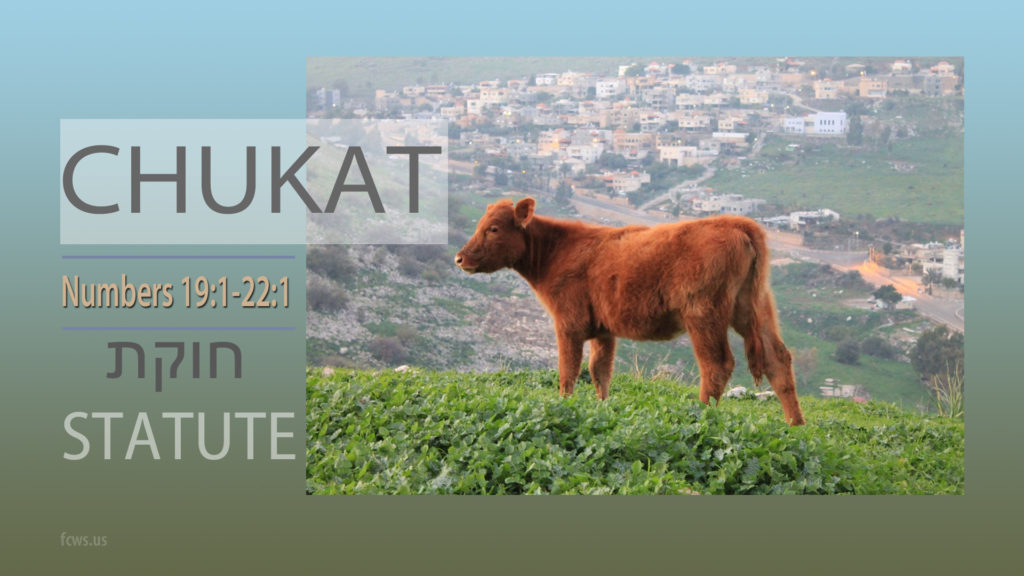 This section of the Bible contains at least three interesting and important subjects. These include the (1) red heifer, (2) waters of Meribah and (3) incident of serpents in the wilderness. The most mysterious of the three is that of the red heifer. A red heifer was chosen, slaughtered and burned completely by the priest. The ashes of the red heifer were collected and preserved in a clean place. Evidently, the ashes were then mixed in water which was used in a purification ritual. Also, continuity was maintained from the ashes of one heifer to the next one that was used in this manner.
 Election is an important concept revealed in the Bible. God chooses whomever He wills for the task at hand. From a human perspective, there may be others who appear better qualified and better suited for the job. Nevertheless, God’s choice is God’s choice. Often related to election is human rejection of that choice. In the section of the Bible that we are considering we see both election and the rebellion against that election portrayed.