 In the Exodus account, God revealed important aspects of His name. In the previous section, we discussed the importance of the name “I will be that which I will be”. God declared that He was not only self-existent but also that He could not be defined. Obviously, the human mind desperately wants to define who and what God is. God simply declared that we cannot. He has chosen to reveal a great deal about Himself through the Bible. This is sufficient for us to serve Him and His purpose. The process of “knowing” His name will, I believe, be an infinite task lasting throughout eternity.
There are two aspects of the concept of “name” that we must consider from a Biblical perspective. Name can mean “an identifier”. God declared this name also in the previous section. He is the “God of Abraham, the God of Isaac, and the God of Jacob”. This is the name by which God chooses to be known as throughout all generations. This is the God revealed in the Bible. We should always be careful to insure that we clearly utilize this name when we are speaking of God. It is our responsibility to insure that there is no misunderstanding here. There are many “gods” in this world. There is only one who is revealed in the Bible.
Another aspect of the concept of “name” used in the Bible is a description of a characteristic or function. The name “I will be that which I will be” fits into this category. The name “El Shaddai” also describes a characteristic of God.
“God spoke further to Moses and said to him, “I am the Lord; and I appeared to Abraham, Isaac, and Jacob, as God Almighty, but by My Name, Lord, I did not make Myself known to them.” (Exodus 6:2-3)
The Hebrew expression “El Shaddai” is translated here as “God Almighty”. I like to consider the construction of the word “Shaddai” as “that is enough”. The God revealed in the Bible is the “God that is enough for_______”, for whatever troubles you, you can fill in the blank.
 “Now this is not the end. It is not even the beginning of the end. But it is, perhaps, the end of the beginning” – Winston Churchill – 1942
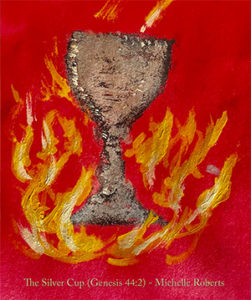 Judah was faced with the ultimate test of leadership. Benjamin had been found guilty of stealing Joseph’s cup and was destined to be thrown into prison for the rest of his life. Judah approached Joseph and proposed that he be imprisoned in the place of Benjamin. Judah laid down his life for the sake of his father and his brothers. In the words of Messiah Jesus, Judah took up his cross. This was the ultimate test of leadership. As a result, Judah became the unquestioned leader of the clan. Jacob, as a prophet, would recognize this through his prophecy concerning Judah.
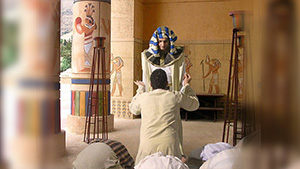 The portion of the Bible recorded from Genesis 37-50 gives an account of the character of two men, Judah and Joseph. This is prophecy because it provides the foundation for subsequent leadership in Israel. When Israel finally possessed the land following the Exodus, the tribes of Judah and Joseph received the territory of the central highlands from the Judean wilderness north to the Jezreel valley. This is the area of the land that is most significant from a spiritual standpoint. It is referred today in the international media as the “Israeli occupied West Bank”. It is, without doubt, the most highly contested real estate in the world. During the First Kingdom era (1447 – 586 BC/BCE), the tribes of Israel were most often divided into two groups; Judea in the South and Ephraim (Joseph) in the North. Ultimately, Judea was predicted to be the primary vessel of redemption (see Jacob’s prophecy – Genesis 49:8-10).